Constructing Certainty: Industry weighs how to make Early Contractor Involvement the default

14th Jul 2026

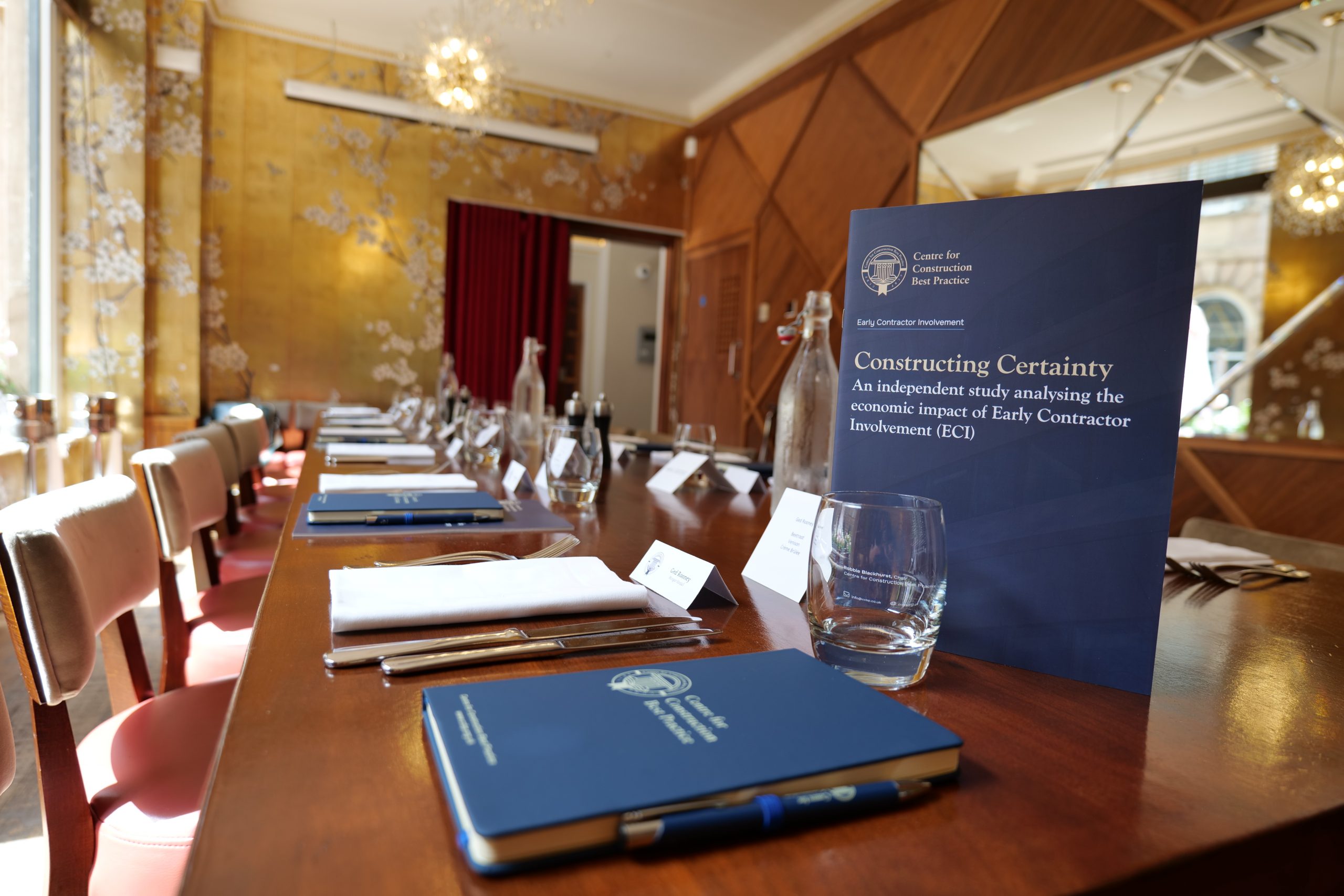
The Centre for Construction Best Practice hosted an industry roundtable to discuss the findings and recommendations of its white paper, Constructing Certainty, which examines the impact of Early Contractor Involvement (ECI) across public sector construction projects.

The research draws on data from 55 main contractors across 412 completed projects, making it one of the most comprehensive evidence-based studies of ECI in the UK built environment sector.

The white paper makes three core recommendations:

  1. Mandate early contractor involvement by RIBA Stage 2 on public sector capital projects above £5 million.
  2. Strengthen public sector capability and confidence in the use of ECI.
  3. Introduce mandatory value checks so contracts are not awarded on lowest price alone.

The roundtable brought together senior representatives from 12 organisations including Wates, Kier, Gleeds, Currie & Brown, Seddon, Walker Sime, and Morgan Sindall to test the recommendations against industry experience.

Participants included the following representatives:

  • Phillip Woods – National Framework Director, Wates
  • Nick Orton – Pre-construction Manager, Kier
  • Mona Hassan – Quantity Surveyor, Gleeds
  • Paul Hughes – Managing Director, Sterling Services
  • Ged McNicholl – Director, Currie and Brown
  • Katy Harris – Pre-construction Director, Seddon
  • Conor Neild Crabb – Head of CCBP
  • Alice Taylor – Partnerships Manager, CCBP
  • Joe Cooper – Associate Director, Pick Everard
  • Chris Tildsley – Director of Quantity Surveying, Walker Sime
  • Craig Finn – Framework Director, Stepnell
  • Ged Rooney – Pre-construction Director, Morgan Sindall

There is broad support for ECI, but the industry needs a clearer model

ECI adds significant value when implemented well: cost and programme certainty, risk reduction, better buildability advice, and gives clients confidence to make decisions.

However, the group also identified a recurring problem: ECI lacks standardisation. Several participants called for a formal protocol that sets out what ECI entails at each stage.

Ged Rooney of Morgan Sindall stated that ECI’s vagueness makes public bodies wary, commenting, “public bodies are used to working through frameworks, gateways and structured formal approval processes. If ECI is presented only as a principle, rather than a process, it becomes harder for them to defend internally and easier for them to avoid.”

Chris Tildsley of Walker Sime added to this and pointed to the way other parts of the pre-construction process have been formalised, for instance, PCSA processes, practice notes, guidance and defined stages that have clear objectives and outputs. He stated, “The same logic could be applied to ECI.”

The debate is not whether ECI works, but how it should be implemented

The industry debate is no longer about whether early contractor input has value but about how to create a structure that enables its consistent and proportionate use.

The white paper recommends that early contractor involvement should be mandated from RIBA Stage 2 on public sector capital projects with a value above £5 million. This threshold reflects a statistically significant divergence in the data. Below that level, ECI made no measurable difference to outcomes. Above it, the benefits were clear and consistent.

Participants recognised the logic. As Katy Harris of Seddon observed, “we’ve started to change, but not enough. So why not mandate it, if it will make improvements?”

At the same time, the group questioned whether “mandate” risks resistance if it was not supported by clear guidance, proportionality and a shared definition of ECI.

Several participants suggested that a “comply or explain” approach where ECI above the threshold becomes the expected route, though clients can justify exceptions.

Mona Hassan, Quantity Surveyor at Gleeds suggested embedding ECI into the contractor selection process and PPQs, so early engagement proposals become part of the contract.

This would shift ECI from being optional and inconsistent to being the default position, while still allowing flexibility for project complexity, funding status and client readiness.

Public sector clients need more confidence

Many public sector clients face intense governance, funding and capacity pressures that make early engagement difficult even when the benefits are understood.

Ged McNicholl of Currie & Brown said confidence in implementing ECI comes from process and governance, as opposed to capability, stating “the primary barrier is not client capability, it is client confidence and the absence of a trusted, structured process.”

McNicholl emphasised that public sector clients do not need to be told how to do their jobs; instead, they need “useful market knowledge, practical guidance and intelligent support that fits within the constraints they face.”

Trust and transparency remain central challenges

The roundtable explored the commercial culture needed to make ECI work.

Successful ECI relies on earlier, frank conversations about cost, risk, buildability and deliverability. Yet participants recognised that this can be difficult in a sector where contractors are often competing on tight margins and where clients are under pressure to demonstrate value for money through competitive pricing.

Phillip Woods of Wates noted, “open-book working, cost-plan review and early risk commentary can only succeed where there is sufficient trust between client, consultant and contractor.”

This does not mean removing competition. Rather, it means creating a process where early contractor input is properly scoped, fairly procured and clearly evaluated.

One practical suggestion was to include contractor commentary on the cost plan as part of the evaluation process to identify gaps and assumptions before appointment, so clients can assess the quality of thinking, not just price. Used well, this distinguishes a low price from a deliverable one.

The industry needs to move beyond lowest-price behaviours

The third recommendation calls for mandatory value checks so that contracts are not awarded on lowest price alone.

Attendees couldn’t recall a recent project awarded on lowest cost alone. Most Advantageous Tender (MAT) criteria has become near-universal “on paper”, but its practical effect remains limited.

Chris Tildsley said for many clients, the pressure is practical not cultural, stating, “clients often have a defined budget sometimes from, say, three years ago… Costs have shot up, so there’s no viability anymore.”

If a scheme is unaffordable, it will not be delivered, so costs must stay central. The real test, and where this recommendation and value checks fit, is whether the price being accepted is realistic and deliverable.

Lowest-cost appointment is the easiest decision to defend, but ECI gives clients a stronger value-for-money position by testing the cost plan before key decisions are locked in.

Whole-life value remains difficult under current funding structures

Ged Rooney and Katy Harris noted a structural divide between capital and operational budgets; those procuring a building rarely pay its long-term operating costs, leaving sustainability decisions vulnerable when budgets tighten.

Ged noted occupancy defects are “a hidden cost that rarely feeds back into procurement decisions.”  ECI alone cannot fix the divide, but earlier involvement helps surface long-term savings and trade-offs sooner.

A practical route forward

The roundtable reinforced the central argument of Constructing Certainty: Early Contractor Involvement has real potential to improve project outcomes, but only if it is used consistently, clearly and proportionately.

The group supported the direction of travel, while highlighting the need for:

  • a clearer and standardised definition of ECI
  • proportional application above the £5 million threshold
  • a “comply or explain” model to support adoption without unnecessary rigidity
  • better public sector guidance, templates and assurance
  • clearer links between ECI, PCSA and contract award
  • stronger value checks to test deliverability, not just price
  • a shift in language from cost saving to cost certainty and better value

The research provides a strong evidence base. CCBP is committed to continuing to work with industry, public sector clients and policymakers to turn it into practical guidance.

Research context

CCBP launched in October 2024 alongside its founding industry and academic advisory group which is made up of tier one contractors and leading universities.

In April 2025, the group convened to identify priority issues facing the construction sector. Early Contractor Involvement emerged as a clear focus, reflecting industry concerns around cost certainty, programme reliability, risk allocation and project outcomes.

CCBP’s first white paper, Constructing Certainty, analysed 412 completed public sector projects, mapping contractor appointment timing (RIBA 0-4) against final cost and programme performance. Its findings show cost and programme remain stable when contractors are appointed at RIBA 0-2, after which, cost and programme overrun accelerate sharply.

The findings have been submitted to government and presented to the All-Party Parliamentary Group for the Built Environment, and CCBP continues to engage with policymakers on wider adoption.

To discover the findings, or get involved in future research, download the whitepaper.

Download ECI Report